.webp)


.webp)

If you’ve never stored a household before, the idea can feel strangely mysterious. You understand the beginning of the process—packing, loading, and watching your furniture leave the driveway. You understand the end—delivery day, when everything arrives and life starts to feel normal again. But the middle part is where uncertainty creeps in. Where does it all go? Is it stacked in a way that could bend something? Does anyone check it? Could it shift or fall over time? Will your furniture come back smelling musty, scratched, or “not quite the same”?
Those questions are completely normal, especially for first-time storage users. Most people don’t store furniture often, and when they do, it’s usually during a high-stress season of life: a renovation, a move with a timing gap, a downsizing transition, or a change in family circumstances. When you’re already juggling enough, storage can feel like a leap of faith.
The good news is that furniture storage doesn’t have to be uncertain. When storage is professionally managed as part of a moving and logistics service, you’re not dropping your belongings into a personal storage units facility and hoping for the best. You’re placing them into a controlled process where responsibility stays clear and the goal is predictable protection from pickup to final delivery.
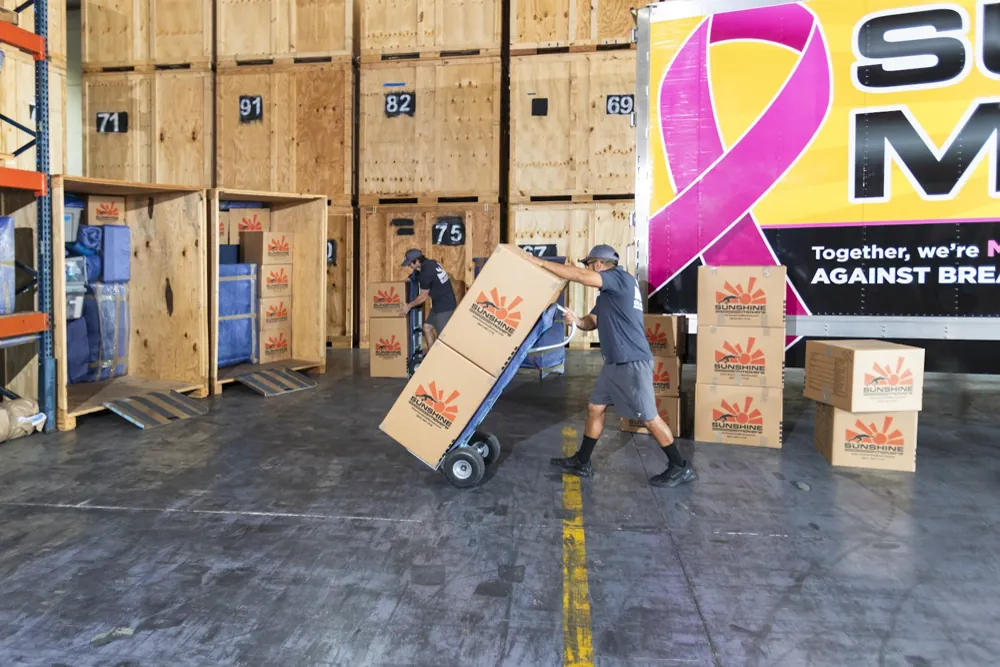
Sunshine Movers offers professionally managed, secure warehouse storage—an extension of moving and logistics, not self-storage. There are no drive-up storage units and no customer-access storage areas. Warehouse access is limited to authorized personnel only, with camera monitoring throughout. Items are inventoried upon intake, and Sunshine maintains chain of custody from pickup through storage and final delivery. That model changes what “storage” looks like in real life, and it makes the middle part of the story far more reassuring.
Storage Isn’t One Moment, It’s a Managed Period of Time
A common misconception is that storage is a single event: items get put somewhere and sit untouched until you call for delivery. In a self-managed storage setup, that might be close to the truth, because customers often control their own units and come and go as they please. In a professionally managed residential storage environment, storage is more like a managed holding period within a larger logistics plan. That means your furniture isn’t treated like a pile that gets stuffed into a room. It’s treated like a set of belongings that must remain protected, stable, and ready for a clean return to your home.
The “middle” is designed to be boring in the best possible way. No surprises. No unknown access. No repeated shuffling. No unnecessary handling. When people say they want peace of mind, that’s what they’re really asking for: they want nothing dramatic to happen to their furniture while it’s out of sight.
Are Items Stacked or Shelved?
This is one of the first questions people ask, and it makes sense. We all imagine worst-case scenarios: a sofa balanced on a fragile table, boxes crushing cushions, a bed frame leaning at an odd angle. The reality is that furniture storage is typically a combination of structured staging and careful placement, and the safest approach prioritizes stability, weight distribution, and surface protection.
In professionally managed warehouse storage, furniture is generally positioned so that heavy pieces are stable, lighter pieces aren’t crushed, and delicate surfaces aren’t exposed to unnecessary pressure. Certain items may be placed in ways that resemble shelving or organized zones rather than the “stack it high” approach people fear. The exact layout depends on the warehouse system and the type of items, but the core principle stays consistent: furniture should be stored in a way that preserves its shape and finish, not simply in a way that maximizes cubic footage.
This is also where professional preparation matters. Furniture that is properly protected—pad-wrapped and secured—can be positioned more safely because the protective layers reduce friction and help prevent surface-to-surface contact. Sunshine Movers’ storage process keeps furniture professionally pad-wrapped, which helps protect edges and finishes while items are in their stored position.
In contrast, many personal storage units setups create pressure to “make everything fit,” because you’re paying for a unit size and trying to use every inch. That often leads to overly tight stacking, uneven pressure points, and a storage layout that can change each time the unit is accessed. The difference isn’t just the space. It’s the purpose. A logistics-style warehouse is designed for controlled handling and protected storage, not for repeated customer rearranging.
Are Stored Items Checked?
First-time storage users often imagine their belongings sitting in a dark corner for months, unseen, until delivery day. In managed residential storage, the system is built to reduce uncertainty and maintain awareness, especially at intake. Sunshine Movers inventories items as they enter storage, which creates accountability and clarity around what is being stored.
Beyond inventory, the way items are “checked” is often less about constantly touching or moving them and more about maintaining a controlled environment and secure access. In other words, good storage does not require frequent disturbance of your furniture. In fact, too much interaction can increase risk. The best practice for protecting furniture is often to keep it stable, protected, and undisturbed while maintaining an organized system, monitored access, and warehouse standards that support long-term condition.
Security measures also contribute to this sense of oversight. Sunshine Movers restricts warehouse access to authorized personnel and uses camera monitoring throughout. That combination supports the kind of accountability first-time storage users want without creating the risk that comes from too many people handling items unnecessarily.
If you’re used to thinking about personal storage units where customers come and go daily, it can be helpful to reset the expectation: professionally managed storage is designed to be controlled, not trafficked.
Can Items Shift Over Time?
Items can shift in any environment if they were placed improperly, if they’re repeatedly handled, or if the storage area experiences vibrations, movement, or frequent rearranging. That’s why the most important factor is not simply the length of time items are stored. It’s whether the storage process minimizes opportunities for shifting.
In a managed warehouse model, furniture is typically placed with stability as the priority, and once it’s positioned, the goal is to keep it that way until redelivery. Because Sunshine Movers storage is not customer-access and not public-access, your belongings aren’t being bumped by unknown people moving their own items through shared hallways. There’s no “neighbor unit” effect where activity next door can lead to accidental contact. Reduced traffic and controlled custody naturally reduce the likelihood of shifting events.
The other factor that reduces shifting is handling method at intake. Sunshine Movers’ warehouse advantage includes dock-level loading, where trucks pull directly to a loading dock and items move straight from the truck into the warehouse. Fewer handling points means fewer opportunities for the bumps and angle changes that can create unstable placement. The fewer touches an item experiences, the less likely it is to end up in a compromised position.
So yes, shifting is possible in the abstract, but good storage design and controlled handling make it far less likely.
What Affects Long-Term Condition While Furniture Is Stored?
Long-term condition is shaped by a mix of environment, preparation, and consistency. Environment is especially important in Florida, where heat and humidity can influence wood movement, fabric moisture retention, and musty odor development if conditions aren’t controlled. Preparation matters because padded and wrapped furniture is shielded from incidental contact, dust exposure, and surface abrasion over time. Consistency matters because repeated access and re-stacking increases risk. Even if every individual movement is careful, repeated movements create more opportunities for something to go wrong.
One of the biggest hidden drivers of condition issues is “unknowns.” In self-storage, you don’t always know what other customers are storing nearby, how often people are moving through the property, or whether doors are frequently left open, letting humidity surge. Operators generally don’t control what customers bring into a facility. That can introduce pest concerns, moisture issues, and cross-contamination risks that have nothing to do with your own belongings.
Sunshine Movers’ warehouse model reduces those unknowns by controlling what enters the storage environment, maintaining limited access, and keeping custody within one company from start to finish. That doesn’t just reduce theft risk; it reduces the everyday variability that can affect condition over time.
How Is Damage Prevented While Furniture Is in Storage?
Damage prevention is a chain, and it’s only as strong as the weakest link. Many people focus on the storage room itself and forget that most damage happens before items are stored. The prevention story begins with professional handling, wrapping, and padding, continues with safe loading and intake, and finishes with stable placement in a controlled environment.
Sunshine Movers’ storage approach prevents damage through a combination of protection and process. Furniture remains professionally pad-wrapped, which reduces surface damage and cushions edges. Items are inventoried upon intake, supporting organization and accountability. Warehouse access is strictly limited to authorized personnel, with camera monitoring throughout, which reduces the risk of unknown contact. And dock-level loading reduces the obstacles that cause bumps and drops in typical self-storage scenarios, like ramps, elevators, and narrow hallways.
Perhaps the most important prevention factor is chain of custody. When one company maintains responsibility from pickup through storage and final delivery, you avoid the stress and risk of multiple handoffs. There’s no moment where your furniture becomes “someone else’s problem” or where unknown individuals access the space. That continuity reduces both physical risk and the emotional stress that comes from not knowing what’s happening behind the scenes.
The Storage Experience First-Time Users Expect vs. What Actually Happens
First-time storage users often imagine a personal storage units scenario because it’s the most familiar concept. You picture driving up to a roll-up door, unloading piece by piece, trying to stack everything safely, and hoping the unit stays clean and dry. That can work for certain situations, but it also introduces more effort, more handling, and more uncertainty.
Professionally managed residential storage is different in a way that’s hard to appreciate until you’ve experienced it. Your items don’t become an ongoing DIY project. They enter a controlled warehouse process where your job is not to “manage the unit,” but simply to decide when you want pickup and when you want delivery. The middle part is handled by a professional team with clear responsibility and a system designed to reduce risk.
If you’re the kind of person who values knowing who is accountable, how things are protected, and why the process is safer, managed storage tends to feel far more comfortable than personal storage units. It replaces “hope” with a plan.
Storage Should Feel Predictable, Not Like a Mystery
If you’re storing furniture for the first time, the biggest relief is knowing that the “middle” of the process is designed to be calm and controlled. Your belongings shouldn’t be in a space where unknown people come and go, where you’re forced to restack items repeatedly, or where responsibility becomes unclear.
Sunshine Movers’ residential storage is professionally managed warehouse storage with controlled access, inventory awareness, and full chain of custody from pickup to final delivery. It’s not self-storage, and it’s not a public-access facility. It’s a logistics-style solution built to keep your furniture protected, stable, and ready for smooth redelivery when your home is ready.
If you’re weighing storage options and want a clear plan you can trust, Sunshine Movers can help you choose a storage approach that reduces handling, reduces risk, and removes the uncertainty that first-time storage users feel most.


